Creativity by Dave Hileman

I took this photo at the Teton National Park several years ago. I did not like it. The weather that day was damp and usually raining, heavy clouds. Then for a brief time there was a bit of a break and we could see the mountains for the first time and I shot this. Never liked it. So the other day, for something different, I made it look more like a painting. I like it better just not sure how much. Thinking about creativity, what is more amazing than the creation itself?

"For the LORD is the one who shaped the mountains, stirs up the winds, and reveals his thoughts to mankind. He turns the light of dawn into darkness and treads on the heights of the earth. The LORD God of Heaven’s Armies is his name!" Amos 4:13 NLT

<untitled> (4)-Edit.jpg

Let's Talk Money! (part one) by Dave Hileman

Travel is expensive, period. Unless you plan to bike or walk and sleep along the side of the road it costs money to see the sights in this large, beautiful country. Travel that to me is well worth the cost. This is not a discussion on whether buying a travel trailer is a good idea, we will have that sometime, but about relative costs now that we own one. At first glance it seems pretty cheap as decent, moderate hotels are well over $125 a night most places often lots more and camping is a quarter of that. But as in most things there is more. We pay personal property tax, insurance and storage fees for our trailer. They are equal to about 10-12 days in hotels. So with the mileage penalty from towing you basically break even for a two week trip. This year we are traveling for three weeks and about 3000 miles. We will save about $1500 on lodging for the trip figuring all ownership expenses. Of course, this is our fourth excursion this year and the two were lots fewer miles, so we are really ahead before we leave. But just considering this trip it is a savings but not as significant as first assumed. 

We also think we have both tangible and intangible value as well. For example, we eat breakfast, lunch and dinner in house unless we wish to eat out. And when we do eat out we often have lunch or another dinner from the restaurant meal leftovers. This is ultimately healthier for long trips and you get to be more selective about restaurants. Coffee (lots of coffee) and other drinks and snacks are much less expensive when you get them from your fridge. We sleep in our own bed, shower in our own bathroom and live in our own environment - clean or less clean it is our mess. I like that aspect. To set up or hitch up the Oliver is easy and quick, so that is a non-issue unless it is raining hard or backing in a slot is tight. It really takes not more or much more time than unloading luggage and making a second trip to the car for what I forgot. I like the easy access to clothes, shoes, equipment etc from closets in the trailer. We have a nice entertainment system- use it little but it is there and if we have WIFI, connect to lots more. It is comfortable to read, work on photos, plan the next day or write.

Camping is often in nice places, not always, sort of on a par to hotel choices. You don’t know for sure what kind of space you will get anymore than you know how loud the folks are in the adjacent room in the hotel. It is hard to put a financial value on a beautiful park campground with a great view. And to stay in National Parks, like Acadia where we will spend six nights for $90 and walk across the road to the ocean, wow. 

Finally the longer the time traveling, even factoring in distance, the more savings. When we travel to Alaska next summer for four months even with the mileage costs we will save thousands. In fact we would not be able to take that kind of trip without the RV. So we deal with the fixed expenses, occasional repairs and service, and the mileage penalty while seeing sights we could otherwise not easily afford. And that is a hard to measure value until you are up early - already in a beautiful National Park seeing sunrise over the mountains, the ocean or a lake, mist rising everywhere, with beautiful light and then you know the experience is priceless.

I mean who hasn't been to a cash register museum?

I mean who hasn't been to a cash register museum?

On Top... by Dave Hileman

...of Old Smoky, actually. This is a shot from several years ago taken from the observation platform on Clingman's Dome in the Great Smoky Mountain National Park. 

<untitled> copy-Edit.jpg

Route Planning by Dave Hileman

There are different types of route planning depending on the type of trip. Going to the beach for a week, not much planning on how to get there. Going to Disney for a week, lots of planning for fast passes, food and where are the closest ATMs. We are not doing that kind of trip. Once we pick a furthest destination than we start planning. 

This fall Saint Croix Island NHP on the Canadian and Maine borders is the apogee of the trip. We also determined that we wanted to complete the NPS units in the New England states excepting NYC. Admittedly this is not everyones idea of a vacation. Traveling to one or more sites each day, rarely staying too long at any camp site and lots of driving. I like the driving so that is not an issue and once we chose to visit and photograph all 417 NPS units, the outline of multiple trips was set. 

So, how do we go about planning a route? The first stop is not usually too close to home because closer ones are easier to get to so, on this trip, stop one is Scranton, PA - home to a mythical paper company and our first new National Historic Park, Steamtown. We choose this because it is an easy alternate route to NE only slightly off our normal travel. Also, the bonus is that there is a NP scenic river not too far away in NY that we will stop at shortly after leaving Steamtown. The next stop is defined by the campground being central for three sites, one new and two we visited long ago but before photos. The super bonus is a meal at the CIA in Hyde Park, NY. So, trips are structured by NPS units, available camping and FOOD. Often by food. Usually by food and or ice cream or bakeries.

We are then going to Weir Farm in Connecticut. Here is another issue not just for NP sites but lots of places. Weir Farm is only open Wednesday to Sunday so we had to adjust our schedule to arrive when they open on Wednesday and that was not the first iteration of this trip. This unit has very limited parking so when you are towing that becomes a part of planning. On Apple Maps I bring up the satellite images and look for close alternatives for parking if the lot is full when we arrive. 

Next stop is late afternoon in Providence RI and that brings up another factor, traffic. We need to leave the farm early enough to not be a part of rush hour on 95 headed out of NYC. 

Not going to go over the whole itinerary but that is a sample. So, how is the planning done? We use paper maps from AAA, online maps, and past experiences to chart the broader course. But this is general process at this point, a specific plan follows and that will be another post. The best part of planning is that it allows us flexibility without missing what we really want. Lots of things unexpected arise: traffic, road construction, places to see we did not know about or ice cream shops the must be tried. A plan allows you to stop and adjust often and we do.
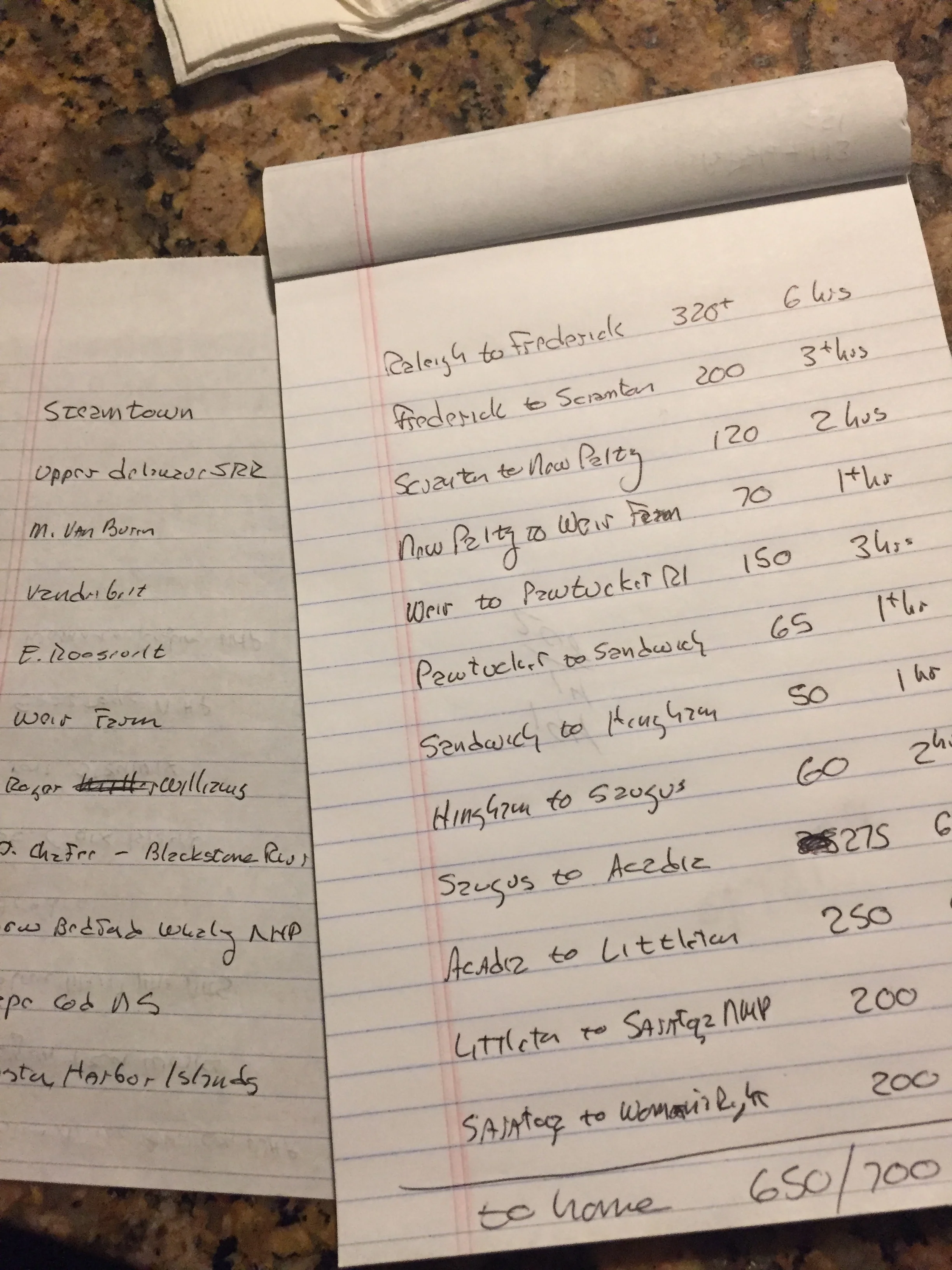
Planning Lists On left list of NPS units, right, distance between major stops so I know how to plan a day and where to camp.

Planning Lists On left list of NPS units, right, distance between major stops so I know how to plan a day and where to camp.

Silent Witness by Dave Hileman

This is the apex of the fighting at Gaines Mill. The Watt house was abandoned by the widow who lived here hours before the battle. She never returned from Richmond. https://www.nps.gov/rich/index.htm

_DSF4137.jpg

New Normal (2 photos) by Dave Hileman

This is not so much to decry what we have lost, after all, Lincoln, McKinley, Garfield and Kennedy were killed and other presidents shot and wounded while in office so there is no safe and secure time in the past even if  we felt more secure. No this is about how simply taking a photo, this of the "other side" of the White House, is more difficult today in many of the parks as more places are off-limits where you could once go. This is an extreme case. The chain barrier, then service vehicles, then concrete barriers, then emergency vehicles, then double fence, walkway now only for officials and a newly multi-barbed and higher fence. Lots of "stuff" in the way.  

_DSF8527.jpg
https://c1.staticflickr.com/3/2825/10414250576_f0b4137368_b.jpg

https://c1.staticflickr.com/3/2825/10414250576_f0b4137368_b.jpg

Welcome to Journeys by Dave Hileman

Much looks just the same today as it did last week but Two Lane Touring is making a change that is more significant that it first appears. "Journeys" will occupy the space that has been "No Itinerary" for the last three years and for two years before on the old site. This was an eclectic place for photographs that did not fit under the National Park Service portion of the TLT and, sometimes, it still will. However, there are lots of planned differences too. 

We will be writing longer pieces one or two or even three times a week on topics related to our travel: selecting routes, planning, gathering information, and preparation among many others. Related to how we travel is the camping aspect. That too will be a focus of Journeys. Again lots of preparation for travel when you are living with what you tow. We will talk about food, campsites, set up, issues finding a parking space when you are 36 feet long, what needs repaired or replaced, and how you camp free off the grid are a few of the subjects we will cover. We will review “Stuff That Actually Works” to make the trip easier or more productive from simple to critical like what flashlight can you depend on, what will keep your coffee hot, what generator works and how do you find WIFI while traveling. 

We will share why we use travel and camping check lists (five or six of those) that help us arrive with what we need, usually:) We will talk about planning verses flexibility, reservations verses looking for a place as it gets dark and what is “restaurant instinct.”

The most challenging change is one that will occur this September. We are going to do a daily travel diary while we travel along with the photos, or as much of one as we can. Our three week trip to New England this fall is a trial for us for the four month Alaska trip next summer. Plus several short jaunts in between.

On the fall trip we will travel across eleven states, visit and photograph around 20 National Park sites including 14 for the first time. Which leads to the last component, photography. This is after all a photography site first and I intend to share more of how and why and what - than I have done in the past. I am still very much a learner and I find having to explain post effort helps enormously for the next photo. So, you won’t confuse this for a teaching site but I hope to unfold a bit behind the photo. And talk about some of the gear I use.

So, thanks to those of you who often visit Two Lane Touring. Your participation adds to our joy. Please leave comments, drop us a note or ask questions, we appreciate each of you.

IPhone

IPhone

High Nest by Dave Hileman

What a secure place for a nest inside the ring atop the steeple at Christ Church in New Bern. It is made with the moss growing on the trees in the church yard. 

Even the sparrow finds a home, and the swallow builds her nest and raises her young at a place near your altar,
O Lord of Heaven’s Armies, my King and my God!
What joy for those who can live in your house, always singing your praises.          Psalm 84:3,4 NLT

_DSF4505.jpg

The Vinegar Bible by Dave Hileman

This bible was given to Christ Church in New Bern by King George II in 1752. The bible was published in Oxford in 1717 by John Baskett, the King's printer. This folio edition of the King James Bible would be a presentation piece piece for use in churches and the homes of the aristocracy. It had one major issue, poor proofreading it was riddled with misspelled words and worse. The Parable of the Vineyard became the Parable of the Vinegar, hence the Vinegar Bible. It also gave rise to a phrase we use today, "basket case" referencing a total mess as in that old car is a basket case and unlikely to be repaired. 

_DSF4494.jpg
A rather rare and valuable bible

A rather rare and valuable bible

First - almost! by Dave Hileman

This is one of the first trip digital photographs I ever took. It is at a Frank Lloyd Wright house, Falling Waters, in the Laurel Highlands of Western Pennsylvania. The house was built in 1935 for the Kaufmann family - prominent merchants in Pittsburgh. Loved going to the downtown Kaufmann store growing up in Pittsburgh area with lunch at the Tic Toc Room.  American Institute of Architects named Fallingwater the "best all-time work of American architecture." It was opened to tours in 1964. Worth a trip. 

BYW the camera was a Nikon 40 that was never off "auto."

100_0013.jpeg

River Walk by Dave Hileman

We took about a 2 mile hike along the Pee Dee River at Morrow Mountain State Park in NC. It was actually along now what is called Tillery Lake. It was nice for about the first mile than it was not well maintained. There were lots of fallen trees to clamber over, steep and crumbling path at the edge of the river and super hot, even before nine. We ended about 300 yards from the dam and watched scores of Osprey diving for food and some GBH as well. We were advised to watch for rattle snakes as they were "on the move" and with all the rocks and roots we were cautious as well as hot. 

Nice start at the parking lot.

Nice start at the parking lot.

One of several skittish Great Blue Heron

One of several skittish Great Blue Heron

Nice Osprey, about 150 feet was as close as one got

Nice Osprey, about 150 feet was as close as one got

The dam, turn around point

The dam, turn around point

Reed by Dave Hileman

On a low mountain at Morrow Mountain State Park on a hot and humid evening a hazy sun sets. 

"He will not crush the weakest reed or put out a flickering candle. He will bring justice to all who have been wronged."  Isaiah 42:3 NLT

_DSF4313.jpg

Drama Desk (2 photos) by Dave Hileman

American novelist Eugene O'Neill, Nobel laureate in Literature, wrote at this desk while he lived at Tao House, his home near Danville, CA. It was here he wrote: The Iceman Cometh, Long Day's Journey into Night, and A Moon for the Misbegotten. His personal life mirrored the tragic and difficult people he wrote about. His marriages and his children did not fare too well. The daughter, Oona, he disowned because at 18 she married the 54 year-old Charlie Chaplin, actually lived longer and more fruitful life than her two siblings both of whom committed suicide. The second photo is of the living room just off the den where he wrote. The home is beautiful in a idyllic setting and a far cry from the lives lived here. It is a National Park site but rarely visited. There were 3971 visitors for 2017 the year we were there.

_DSF6020.jpg
_DSF6017.jpg

Welcome Landmark by Dave Hileman

Scotts Bluff (usually with no apostrophe) in Western Nebraska was one of the primary waypoints on the Oregon and Mormon trails. Rising steeply 800 feet over the Platte River, it was an important guide and point of reference as the pioneers needed to be over the Rocky Mountains before winter, this aided them by knowing arrival here beyond a certain date they likely would not make it that year. The road up makes this sweeping curve and then through a tunnel. At the base you can walk beside ruts from the thousands of wagons that made this journey west. 

<untitled> (5)-Edit.jpg

Safe Harbor by Dave Hileman

This is another panorama shot - taken at Bass Harbor, Maine. The village of Bass Harbor is on the right side and the village of Bernard on the left side. A favorite lobster pound, Thurston's is in Bernard and an excellent harbor side restaurant in Bass Harbor, The Seafood Ketch. Both will show up in Eats! someday. 

_DSF4548.jpg